
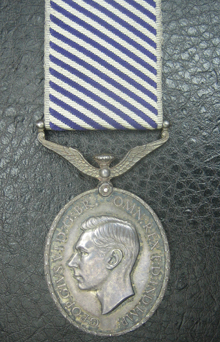
Full medal write up


DISTINGUISHED FLYING MEDAL, G.VI.R. ‘1250914. SGT. P. MALONEY. R.A.F.’
D.F.M. London Gazette 29 December 1942. The original Recommendation, dated 27 October 1942, states:
‘Sergeant Maloney has been in this squadron since October, 1941 and has completed 32 sorties of 194.10 hours. He has completed 15 sorties with Pilot Officer Jeffreys and on the last occasion on which he flew with him, the Captain baled out the remainder of the crew with the exception of the Wireless Operator on returning to this country from an attack on Duisburg. On this occasion, Pilot Officer Jeffreys attempted to land at Martlesham and he retained his Wireless Operator in order that he could assist him and operate the emergency undercarriage system. Sergeant Maloney carried out this task on this occasion coolly and correctly, but it is unfortunate that the third engine failed after reaching the coast and the aircraft crashed. Sergeant Maloney's work has always been of the highest order to which I can personally testify. He carried out his duty coolly and calmly when in difficulties and is of considerable assistance to his Navigator and to the Captain. For his long record of good work in the air and on the ground, I recommend the immediate award of the Distinguished Flying Medal.’
M.I.D. London Gazette 8 June 1944.
Patrick Maloney joined the Royal Air Force and served during the Second World War as a Wireless Operator with 49 Squadron, flying Lancasters. On the night of 6-7 September 1942 his Lancaster, R5752, piloted by Pilot Officer Gordon Sydney Jeffreys, took off from R.A.F. Scampton at 0116 for a raid on Duisburg. Whilst on their bomb run their Lancaster received three direct hits from flak, during which time P/O Jeffreys, the 2nd pilot, Sgt Gregory-Coleman R.A.A.F. and the Wireless Operator, Sgt Maloney were wounded. P/O Jeffreys managed to nurse his Lancaster back to England where over Orfordness he ordered four crew members to parachute to safety. P/O Jeffreys remained at the controls in order to attempt a safe landing with his wounded comrades onboard. Despite his wounds, Maloney was retained in order to help with the landing. A belly landing was made at Martlesham Heath airfield, but sadly too late for Sgt Gregory-Coleman who had succumbed to his injuries.
In addition to Maloney’s Distinguished Flying Medal, for his gallantry on the same night, the Lancaster’s captain, Pilot Officer Gordon Sydney Jeffreys, was awarded the Distinguished Flying Cross (London Gazette 6 October 1942), the original Recommendation stating:
“One night in September, 1942, Pilot Officer Jeffreys was the captain of an aircraft detailed to attack a target at Duisburg. After delivering his attack, but whilst still in the target area, Pilot Officer Jeffreys' aircraft was hit by anti-aircraft fire; one of the starboard engines was put out of action and the second pilot was severely wounded. Pilot Officer Jeffreys received injuries to his hands but he was able to control the aircraft and so continued the return journey. Whilst over the Dutch coast the other starboard engine failed and preparations were made to abandon the aircraft. On reaching the English coast the port inner engine started to fail and Pilot Officer Jeffreys ordered the crew, with the exception of the wireless operator, to abandon the aircraft. He then continued in search of an aerodrome, but when at a height of 1,000 feet the port inner engine failed completely and a crash landing was made, successfully. Pilot Officer Jeffreys displayed courage and devotion to duty of a very high standard.”
Maloney went on to flying a further 3 sorties with 49 Squadron, his last and 32nd sortie being an attack on Genoa on 22 October 1942. He subsequently volunteered for a further tour with 83 Squadron (Lancasters), having been commissioned Pilot Officer in the Royal Air Force Volunteer Reserve. Promoted Flying Officer on 14 April 1943, and advanced Flight Lieutenant, he was additionally Mentioned in Despatches. He was killed on 18 August 1944, when, returning from a day raid, his Lancaster PB188, descending through cloud, suddenly went out of control. A number of the crew bailed out of the aircraft before the pilot was able to gain control and land the aircraft safely, but Maloney, who was the wireless operator was one of those to baled out, was killed when his parachute failed to open. he is buried in Islington Cemetery, London. Further details on Maloney came be found here:
https://www.49squadron.co.uk/personnel_index/detail/Maloney_P
Condition NEF. Sold with copy of original recommendation, which additionally lists his sorties with 49 Squadron.
A very fine D.F.M. awarded for gallantry in addition to continued exceptional service during a tour.