
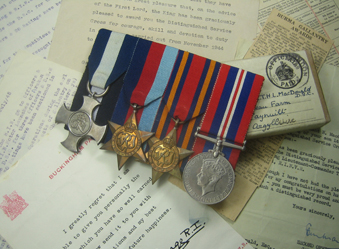
Full medal write up


DISTINGUISHED SERVICE CROSS, G.VI.R., THE REVERSE OFFICIALLY DATED ‘1945’; 1939-45 STAR; BURMA STAR; WAR MEDAL 1939-45.
D.S.C. London Gazette 10 July 1945:
‘For courage, tenacity and devotion to duty whilst serving in Light Coastal Forces, in operations lasting four months, frequently performed under rapidly changing conditions and with difficult lines of communications, on the Arakan Coast.’
The original recommendation states:
‘These awards are for the amphibious operations during the early part of the year in Burma and recognise many acts of gallantry on the approaches to landing beaches and among the Chaungs (waterways). Lieutenant-Commander T. H. L. MacDonald led a M.L. Flotilla that accounted for many Japanese craft trying to escape from Ramree Island.’
One of only eight awards of the D.S.C. to the Royal Indian Navy in the Second World War.
Thomas Henry Lewin MacDonald was born on 25 February 1908 and was educated at Loretto School in Musselburgh and at Cambridge University. Employed as a senior agricultural assistant by Begg Sutherland & Co. in India in the 1930s, he was also a member of the Bihar Light Horse.
In the summer of 1941, on applying for a commission in the Royal Indian Naval Volunteer Reserve, he reported to Fort William in Calcutta, and on passing his medical he was appointed a Temporary Lieutenant in July. A swathe of specialist courses ensued, from seamanship to signals, and gunnery to navigation, following which he appears to have been employed as a staff officer. Hence his appointment to a staff role in the Royal Indian Navy’s Coastal Forces in August 1942.
By February 1944, he was serving as a Naval Liaison Officer to XV Corps on the Arakan front, a role in which he did ‘extremely well’ and for which he was recommended for promotion. And that advancement arrived in the following month, when he was appointed an Acting Lieutenant-Commander and senior officer of the 55th Motor Launch Flotilla, equipped with 8 Fairmile ‘B’ type Motor Launches (M.L.’s). Commencing active service off the Arakan coast, especially in the period November 1944 to March 1945, the 55th earned their nickname the ‘Nip Nippers’. This was largely on account of the unit’s motor launches ramming numerous small craft which were supporting and supplying the Japanese.
In his capacity as a Flotilla C.O., MacDonald was regularly in action, ‘The Royal Indian Navy 1612-1950’, by Commander D. J. Hastings, R.I.N.V.R., referring to his part in all manner of operations. Based at Chittagong from October 1944, the 55th’s motor launches regularly patrolled off the Arakan coast, mounting hit and run attacks against enemy held harbours, the same tactics used by members of the S.B.S. who were embarked - and disembarked - for like operations.
And the flotilla was also called upon to assist in wider operations, the assault on Akyab in early January 1945 being a case in point. On that occasion, the onerous responsibility of laying buoys to guide the Allied armada assembled on the Mayu River fell to MacDonald’s motor launch, a task successfully accomplished; his motor launch operated to within half a mile of the Japanese batteries but managed to avoid detection. Later in the month, in support of the landings at Myebon, the surrounding waterways were dominated by the presence of his flotilla’s marauding motor launches which had plenty of exciting encounters with enemy supply-carrying launches. Indeed, according to Hastings, the eastern night sky was often lit up by a massive pillar of flame and smoke as the motor launches claimed another victim.
But all such major assaults demanded prior reconnaissance work, the proposed attack on Kyaukpyu (Ramree Island) - being no exception. Hence MacDonald embarking a party of S.B.S. men under Major Livingstone, in order to carry out a recce. of the island’s main harbour and the surrounding area. The S.B.S. party returned safely to a pre-arranged rendezvous four nights later, their mission accomplished.
https://en.wikipedia.org/wiki/Battle_of_Ramree_Island
MacDonald appears to have continued in command of 55th Flotilla until the conclusion of the Arakan campaign and for the rest of the war served back in India. He subsequently wrote a personal account of his wartime experiences, an account that resides in the British Library’s Asian and African studies centre. He was demobilised at Bombay in December 1945 and died in Cuckfield, Sussex in January 1976.
Sold with a quantity of original documentation, including:
1)Secretary of the Admiralty enclosure slip and named Second War Campaign Medals card box of issue,addressed to the recipient at Barguilleau Farm, Taynuilt, Argyllshire.
2)Lt Commander Macdonald named Buckingham Palace forwarding letter for the D.S.C
3) An Admiralty congratulatory letter for the award of the D.S.C., dated 18 July 1945
4) A letter from Captain, H.M.S. Gosling forwarding details of the award of the D.S.C to Macdonald’s father,dated 30 January 1946
5)Two documents giving more details of the reason for Macdonald’s award
6) A wartime newspaper cutting relating to the award of the D.S.C.
Copy research includes MacDonald’s application for appointment to R.I.N.V.R. and his service record; these very detailed. LG, extracts from ‘The Royal Indian Navy’, a digital copy of the ‘The Royal Indian Navy 1939-45’.
Condition EF. A very rare award, with great research potential. This being one of just eight awards of the D.S.C. to the Royal Indian Navy during the Second World War.