
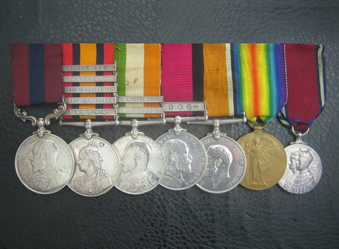
Full medal write up


DISTINGUISHED CONDUCT MEDAL, E.VII.R. ‘SERJT:- MAJ: A. C. WEARNER. NATAL VOLS:’; QUEEN’S SOUTH AFRICA, 1899-1902, 5 CLASPS, TALANA, ORANGE FREE STATE, RELIEF OF LADYSMITH, TRANVAAL, LAING’S NEK ‘284 MED:-SERJT: A. C. WEARNER. UMVOTI M.R.’; KING’S SOUTH AFRICA, 1901-02, 2 CLASPS, SOUTH AFRICA 1901, SOUTH AFRICA 1902 ‘284 MED:-SERJT: A. C. WEARNER. UMVOTI M.R.’; NATAL, 1906, SINGLE CLASP, 1906 ‘LT. & Q.M. A. C. WEARNER UMVOTI MTD. RIFLES.’; BRITISH WAR AND BI-LINGUAL VICTORY MEDALS, 1914-1919 ‘CAPT. A. C. WEARNER.’; JUBILEE MEDAL, 1935, UNOFFICIALLY ENGRAVED ‘CAPT. A. C. WEARNER D.C.M.’
D.C.M. London Gazette 31 October 1902.
M.I.D. M.I.D. London Gazette 23 June 1902 23 June 1902.
Captain Arthur Charles Wearner (1865-1948) was born in Shoreham, Norfolk, on 17 December 1865 and emigrated to South Africa in 1882, settling in Natal. A man of varied interests, he is recorded as having had a keen interest in geology, landscape painting and reading. He was involved in several prospecting ventures, including a Mica mine with Sir Arthur Hime in the Transvaal and also discovered asbestos in the Piet Retief area, but the ventures were not commercially viable.
With the outbreak of the Boer War, Weaner was serving with the Dundee Town Guard and thus qualified for the Talana clasp to the Q.S.A. medal. Joining the Colonial Scouts on 5 December 1899, a unit then being raised by the Natal Government, they were chiefly employed in Zululand and on the border of that country and the Transvaal. Wearner would service with this unit until 26 March 1900, the unit being disbanded in April 1900.
Shortly after, Wearner joined the Umvoti Mounted Rifles, a small Natal Volunteer unit, approximately 85 strong and under the command of Major George Leuchars. This unit had been being doing duty with the Natal Volunteer Brigade since the outbreak of the War and were now on duty guarding the frontiers of Natal and in operations in the adjacent eastern Transvaal. Having attained the rank of Medical Sergeant with Umvoti Mounted Rifles, on 1 October 1900, Wearner was one of 14 Officers and men from his unit to be seconded to the newly formed Natal Volunteer Composite Regiment. He would serve as Sergeant-Major of this unit throughout its entire service until the disbandment of regiment on 31 July 1902.
Natal Volunteer Composite Regiment:
'Upon the final expulsion of the Boer forces from Natal and the general settling down of the northern districts, which had been occupied by the enemy for about nine months in 1899 and 1900, the Natal Volunteer Brigade was demobilised at the request of the Natal Government, which had borne the cost of keeping its forces in the field for a year and was feeling the financial strain. The Commander-in-Chief of the British forces, Lord Roberts, agreed, provided one mounted regiment was left in the field till the end of the war. This unit was formed from volunteers from all the Natal regiments, and was called the Natal Volunteer Composite Regiment. It came into being in October 1900, the units furnishing the volunteer personnel being the Natal Carbineers, Natal Mounted Rifles, Umvoti Mounted Rifles, Border Mounted Rifles, Durban Light Infantry, Natal Royal Rifles and Natal Field Artillery, with necessary detachments from the Natal Volunteer Staff, Medical, Veterinary, Transport and Supply Departments. The strength was 505, in four squadrons.
The unit gained an enviable reputation for its work and many were the encomiums received from the Imperial Army commanders, under whom the regiment or detachments served. Scouting was highly developed, and soon the Natal Volunteer Composite Regiment was famed for this type of work. Amongst its personnel were many men hailing from districts in which it operated, and consequently they possessed valuable local knowledge and many were linguists in Dutch and Zulu. The regiment was disbanded on 31 July 1902.’
For this service with the Natal Volunteer Composite Regiment, Sergeant Major Wearner was Mentioned in Despatches, London Gazette 23 June 1902 and four months later was awarded the Distinguished Conduct Medal, London Gazette of 31 October 1902. According to Recipients of the Distinguished Conduct Medal 1855-1909 by Abbott, Sergeant Major Wearner’s award was the only D.C.M. awarded to the Natal Volunteers Composite Regiment for the Boer war. The exact reason for the award has yet to be established. No awards were made to the Umvoti Mounted Rifles as a unit, thus a unique award.
Post Boer War, Wearner remained with the Umvoti Mounted Rifles, serving first as Regimental Quartermaster Sergeant and as Lieutenant and Quartermaster from 18 March 1906. Research states that ‘he was a popular figure amongst the ranks of the Umvoti Mounted Rifles, and several years later he was presented with a silver plaque by the N.C.O.s and men of ‘B’ Squad as a gesture of appreciation for his service’.
Mobilised for service during the Zulu Rebellion of 1906, the Umvoti Mounted Rifles, forming part of the Umvoti Field Force (popularly as the Leuchars Field Force). Playing a leading part in the quelling of the rebellion, the Umvoti Mounted Rifles, among smaller actions, were present at the searching for Bhambatha's stronghold and the major action against the Zulu’s at Mpukunyoni. See the following for an excellent narrative of the part the units played:
http://samilitaryhistory.org/vol136mc.html
Made ‘supernumerary’ on 18 January 1910, in 1913 Wearner and his wife took over Warrington House, overlooking the Market Square in Pietermaritzburg, and converted it into a successful and well-respected hotel. However with the outbreak of the Great War, on 10 November 1914, Wearner was commissioned Temporary Captain & Quartermaster with the Rand Rifles and served in German South West Africa until his discharge on 16 August 1915 (1914/15 Star). On 28 August 1915, he became Captain in the 1st South African Infantry (The Cape Regiment). Serving with his regiment in Egypt between 21 January and 18 March 1916, the took part in the campaign against the Senussi and were present at the battle of Agagia, 26 February 1916.
https://en.wikipedia.org/wiki/Action_of_Agagia
Though Wearner went on to serve in France from April 1916, he had contracted dysentery whilst on active service German South West Africa and this seems to have set off a range of reoccurring illnesses. Consequently, from the beginning of May 1916, he spent much time in and out of hospital, with his only time with his Regiment in the ‘Field’ being between 17 September and 18 October 1916. After a short period on attachment with the 1st Reserve Battalion in England, he was returned to South Africa as ‘medically unfit’ on 9 January 1917. Reason given ‘Exposure, stress of service and infection’.
In his later, civilian life, he was Vice Chairman of the British Empire Services League in 1933 (for which he received the Jubilee Medal 1935) and was involved with the M.O.T.H.s and the Allan Wilson Shellhole Societies. He continued to run the Warrington House Hotel until 1947, after which he died on 13 January 1948.
Sold with:
1) A portrait photograph of Wearner in uniform circa 1915 wearing medal ribbons for the first four awards
2) A postcard photograph of Officers of 1st South African Infantry, Wearner noted with an x. and again wearing medal ribbons for the first four awards. This stamped sent to his wife in October 1915.
Condition contact wear, generally VF. Sold with a quantity of copied research and digital research including medal rolls, service and medical cards etc.
An extremely fine South African group with a unique D.C.M. to the Natal Volunteers.