Full medal write up


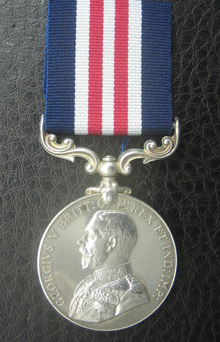
MILITARY MEDAL, G.V.R. ‘1322 SJT: E. W. CHALLIS. 13/AUST: L.H.R.’
M.M. London Gazette 13 March 1919. The original recommendation states:
‘For gallantry in action and devotion to duty. During the operations east of Peronne on 6th and 7th September 1918, Sgt Challis was in charge of a flank guard liaison patrol working between 42nd Battalion and the left flank troops. In spite of very heavy machine gun and artillery fire, he continued to keep up a supply of timely information and repeatedly cleared up hazy situations at great personal risk. From his information we were able to pinpoint the line of flank troops and so make our dispositions conform and the cheerful and thorough manner in which he performed his tasks contributed largely to success of our left Company.’
Edmund Wilkinson Challis was born in Beeaca, Victoria in 1894. He enlisted in the Australian Imperial Force at the place of his birth, 19 July 1915. Challis embarked for the Middle East for service with the 13th Light Horse Regiment, 23 November 1915. Transferring to the 1st Light Horse at Tel-El-Kebir on 17 April 1916, he transferred back to the 13th Light Horse and embarked for England on 28 May 1916. Serving with the Light Horse Training Depot, he advanced in rank to Temp/Squadron Sergeant Major in January 1917 and proceeding to France on 8 April 1918.
‘On the Western Front, terrain and the nature of the war there limited the roles mounted troops could fulfil, but they were still heavily employed. The 13th Light Horse carried out traffic control, rear area security and prisoner escort tasks, and, when the tactical situation permitted, the more traditional cavalry role of reconnaissance. It was most active during the more mobile phases of the war on the Western Front, which included the follow-up of the German retreat to the Hindenburg Line in early 1917, the stemming of the German Spring Offensive of 1918, and the allied offensive of August and September 1918. The regiment's largest engagement was during the operations to capture the Hindenburg "outpost line" between 5 and 9 September 1918 when it provided the advance guard, along a front of 13.5 kilometres, for the advance of the Australian Corps. The regiment had become the Australian Corps cavalry regiment upon its formation in November 1917.
Like much of the Australian Corps, the 13th Light Horse was completing a period of rest and retraining when the war ended on 11 November 1918. After the armistice its personnel were progressively returned to Australia for discharge. The regiment was disbanded on 30 April 1919.’
Challis was awarded the M.M. for his gallantry on the Somme, 6-7 September 1918. He returned to Australia in January 1920 and was discharged in March of the same year.
Condition GVF. With copy service and War diaries (digital).
A very scarce M.M. to the 13th Light Horse. Just 30 M.M.’s to regiment.