
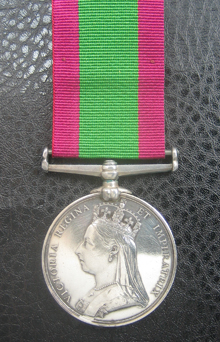
Full medal write up


AFGHANISTAN, 1878-80, NO CLASP ‘LT. H. W. SEYMOUR, 16TH BO. N.I.’
“Lieut. H. W. Seymour served with the regiment throughout, except during an interval between 6 May and 31 July, when he officiated as Aide-de-Camp to General Phayre. Was present at the action of Kach, in which he was slightly wounded. Was Station Staff Officer at Sibi from 8 March till 20 May, 1881.”
Major Henry William Seymour was born on 7 March 1857, from a branch of the Seymour family related to the Dukes of Somerset. Receiving his first commission with the 68th Foot in September 1875, he was later appointed Lieutenant with the Bombay Staff Corps in October 1878. He served in the Second Afghan War during 1880, for a time as A.D.C. to Major-General Sir R. Phayre and was also present at the Defence of Kach. Here, the Headquarters and Left Wing of the 16th Bombay N.I. were attacked on 16 August 1880 while encamped at Kach by a body of 2000 Kakar Pathans. Here after a reported 3 hours of hard fighting, the Pathans were driven off ‘with considerable loss’, however Seymour was slightly wounded in the process. He further led a punitive attack on the villages of Kach and Amadun on 19 August just a few days later. He later served in the Suakin in 1885, however his regiment was not part of the field Force and had no medal entitlement; 1899 Army List additionally confirms Afghan Medal only. Continuing service with the 16th, was promoted to Captain in September 1886, and to Major in September 1895.
He retired from further service on 9 December 1898 and returned to civilian life in Cornwall. Tragically, he was found killed on the local railway tracks on 6 February 1902. As reported in the ‘Army and Navy Gazette’ of 22 February 1902 and other local newspapers:
‘Major Henry William Seymour, retired list, was found killed on the Great Western Railway, near Penzance, on the 6th inst. He had been living in apartments at Penzance since October last, and left his lodgings at p.m. on the 5th inst. to go to the railway station for newspapers. His death must have occurred the same evening. At inquiry held at Penzance into the circumstances a verdict was returned to the effect that Major Seymour was found killed on the railway, but whether accidentally or otherwise there was not sufficient.’
Condition EF, with copy research. Ex D.N.W. 2008.