
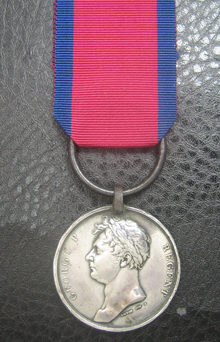
Full medal write up


David Restrick was born in Bradford, Yorkshire circa 1794 and enlisted into the 32nd Regiment of Foot on 5 February 1814. He served in Captain Cassan’s Company during the Waterloo campaign, 16-18 June 1815. Captain Cassan died of wounds received at Quatre Bras. Very soon after the battle, on 24 July 1815, Restrick transferred to the 7th Fusiliers.
Restrick is listed in supplementary roll No3: ‘Return of persons of the Army under the command of the Duke of Wellington who are entitled to the Waterloo medals and who have not received them’. Restrick’s entry notes his medal was sent to Officer Commanding 7th Fusiliers on 7 August 1817. He also appears on the list of men present at Waterloo in the regimental history, this giving him as serving in Captain Cassan’s Company.
At the battle of Quatre Bras, 16 June 1815, as part of Sir James Kempt's 8th British Brigade (along with the 28th, 79th and 95th Rifles) in Sir Thomas Picton's 5th Infantry Division, the 32nd, 662 strong, was involved in some of the heaviest fighting of the day. An Officer of the 32nd would write:
“..We were now in the thick of it, Such a fire of shells, cannon and musketry. I was told by the oldest Officers had never before been witnessed… we were driving them like so many devils. Finding that they advanced rapidly we prepared to charge as soon as they entered the field before us. The corn was breast high, so they got pretty close before they came in sight. The word was given and we advanced with shouts that drowned the fire to the charge. Nothing could have withstood us. They already turned and we were following them down the hill, when I was desired to stay where I was by a piece of shell..”
The 32nd suffered 1 Officers and 20 men killed, 12 Officers and 225 men wounded at the battle.
Two days later, and greatly reduced in numbers, at Waterloo, the 32nd were stationed around the centre and left of the Allied line - undoubtedly the most exposed and dangerous part of Wellington's position. The 32nd endured the worst of fire from the French 'Grand Battery', participated in the defeat of d'Erlon's vast infantry assault (during which time Picton was shot dead and carried off the field by two men of the regiment) and stood solidly in square for several hours repulsing French cavalry charges.
Casualties to the regiment were again extremely high, especially when considering how many Officers and men were lost at Quatre Bras. According to the Regimental history, a further 28 men were killed, with 8 Officers and over 300 wounded. However the latter figure seems at odds with official casualty lists, which notes the number of casualties for both battles at 370 Officers and men killed and wounded, or a 56% casualty rate. These numbers do not take into account Officers and men on other duties such as baggage, sick etc. As such the actual number of men of the 32nd that were in action would have been 50 to 100 less, making the percentage of casualties far higher. This is the case of any regiment at Waterloo and any other battle and is usually not accounted for. After the battle, an officer of the 32nd noted the battalion had been reduced to just 130 men.
Condition NVF or better, original steel clip and contemporary split ring suspension contact wear to edge or better. With copy research. Ex Nobles 2014.
An attractive looking medal.