
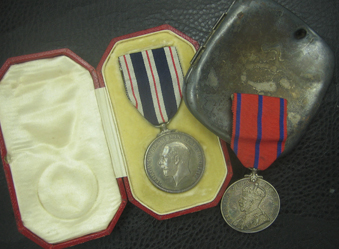
Full medal write up


KING’S POLICE MEDAL, G.V.R., 1ST ISSUE, WITH GALLANTRY RIBBON 'WILLIAM WILLIAMS, COST. METROPOLITAN POLICE.’, IN CASE OF ISSUE, WITH PIN FOR WEAR, CORONATION 1911, METROPOLITAN POLICE ‘P.C. W. WILLIAMS’ WITH PIN FOR WEAR. WITH A SILVER CIGARETTE CASE ENGRAVED ‘WEW’, HALLMARKED BIRMINGHAM 1909, THE CASE DAMAGED WITH A BULLET HOLE.
K.P.M. London Gazette 1 January 1920. The Original citation reading:
“Constable Richardson and Williams were sent to Waterloo Railway Station on 20th September 1918 to meet a train and arrest a man who Surrey Police wanted for housebreaking. When confronted, the man resisted arrest violently and produced an automatic pistol. He shot and disabled Constable Richardson. Constable Williams then closed with him and endeavoured to get the pistol, but the man shot him in the thigh. Constable Williams closed with him again but was thrown down and could not rise; the prisoner ran away. Sergeant Bird and Constable Riches had by this time arrived and chased the man through several streets, finally coming upon him in a wash-house, where they arrested him. The pistol was found in the wash-house still containing five live cartridges.”
William Evan Williams was born Pennsylvania, United States of America, on 15 June 1885 and joined Metropolitan Police on 11 September 1905. Initially serving as a Constable of T Division, due to a boundary alteration, he briefly joined B Division on 3 March 1909, before joining L Division on 10 November that year, Police number 333L.
On 20 September 1918, Constables Williams and Richardson, in plain clothes, went to Waterloo Railway Station to arrest a suspect wanted by Surrey Police. The man resisted arrest and produced Colt automatic pistol and shot Constable Richadson in the knee. Constable Williams then attempted to take the pistol from the prisoner’s hand, but he managed to free his arm and shot Williams point blank in the thigh. Williams again caught hold of the prisoner and the struggle continued until Williams fell to the ground and the prisoner started to run. Williams managed to get up and managed to pursue him for 2 or 3 yards before falling to the ground again and blew his whistle for assistance. Sergeant Bird and Constable Riches then arrived on the scene and after a long chase arrested the man.
The arrested man, Private Milford Granger of the 8th Reserved Battalion, Canadian Infantry, who had deserted three weeks previous to his arrest. He was charged with attempted murder and sentenced to 5 years Penal Servitude in December 1918.
Constable Williams resigned from the police on 26 November 1919, presumably after recovering from his wounds. This after 14 years’ service and aged 34.
On his pension record under ‘Particular mark, defect or infirmary’, is noted “Scar from bullet wound – left thigh, slight lump” and under ‘If injured in the Service..’; “bullet wound left thigh”
It also notes he was married to Alice Jane Williams and lived at 118 York Road, Lambeth, SE1.
The silver cigarette case is engraved with Williams initials ‘WEW’ and has a bullet hole through it. Bullet has penetrated though one side of the case but has left indentation on the other without going through which suggests this was one of the other shots fired, not the one that hit his thigh, the case saving him from another wound. It is of course also possible the bullet ricocheted off the case into Williams’s thigh. Perhaps further details will have appeared in a newspaper or such of the day as it is likely that the bullet hitting this cigarette case either prevented another wound or slowed down the bullet if it was a ricochet.
Approximately 417 GVR 1st type King’s Police Medals for gallantry were awarded to British and Irish Police constabularies and Fire Brigades before the 2nd type came into being in 1933. A total of 226 Medals were awarded to the Metropolitan Police between 1910 and 1940; GVR, 1st and 2nd types and GVIR 1st type, 63 for cases that involved firearms.
Condition NEF, with copy research (digital).
A superb early Metropolitan Police gallantry group that came from the family by decent.