
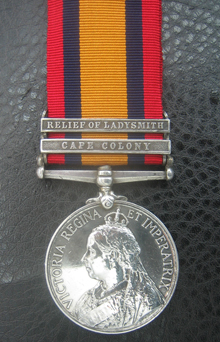
Full medal write up


QUEEN’S SOUTH AFRICA 1899, 2 CLASPS, CAPE COLONY, RELIEF OF LADYSMITH, ‘CAPT. A. J. HANDCOCKS. 1/RL. INNIS. FUS.’
Annesley John Handcocks was born at Weston, Hereford on 13 September 1864 and after attending Rugby school, he was Commissioned Lieutenant on the 7 February 1885. Serving with the 1st Battalion Inniskilling Fusiliers, he was advanced to Captain on 1 July 1891. Having served in Singapore and on Home Service, he proceeded to South Africa with the 1st Battalion on 5 November 1899, following the outbreak of war with the Boers, Captain Handocks was wounded whilst in command of his company at the Battle of Colenso on 15 December 1899. Here Major-General Fitzroy Hart’s 5th Irish Brigade, of which the 1st Inniskilling comprised one of four battalions, were misled due to confused orders, which resulted in the Inniskilling’s advancing through the forward battalions in a loop of the River Tugela where the Irish Brigade could not cross.
The Inniskilling’s were then caught in the perfect killing ground in the loop of the river with no means of crossing. Pinned down and exposed to heavy enemy fire, suffered extremely heavy casualties in under an hour before they were extricated. During this, the third battle of Black Week, the battalion lost 2 officers killed and 9 wounded; 21 other ranks killed and 81 wounded. Altogether the brigade lost over 500 officers and men killed, wounded, and missing.
https://en.wikipedia.org/wiki/Second_Battle_of_Colenso
According to an obituary, Captain Hancocks was hit by “a soft-nosed bullet through the lungs and lay dangerously wounded on the field, sniped at by the Boers from adjoining heights. One of his men, Private Snow, saw the ambulance at a distance and tried to crawl to it to bring help to his Captain. But he too was shot in the gallant attempt. An old Boer farmer was prowling about and seeing the wounded officer, who asked him for water, demanded to know why he, an Irishman, was fighting against the Boers. Captain Handcocks replied: ‘We obey our orders, as I’m sure you do’. The old man gave him some water and ordered that he was to be left in peace – as many of the officers, including Captain Hersey, had their boots taken. Eventually he was picked up and sent to Piter Maritzburg, where his wife – under the care of Lady Randolf Churchill on the hospital ship. “Maine” – came to nurse him..”
Sent to England to recover from his wounds, Hancock was sent to the Depot at Omagh and in 1902 to South Africa. He was advanced to Major on 4 October 1902 and took command of the 2nd Battalion in February 1910 but exchanged to command of the 1st Battalion in November that year, the 1st Battalion who were serving in Tientsin and were there when the Chinese revolution broke out. Having attained the rank of Lt Colonel, Handcocks and the 1st Battalion were ordered to India in 1913 and in February 1914, Handcocks retired from the army. However, on the outbreak of the Great War, he was recalled to service, taking command of the 5th (Service) Battalion Inniskilling Fusiliers but soon after was declared unfit for active service and was once again retired. He died in October 1938. The Queen’s South Africa Medal being his only medal entitlement.
Sold with a large amount of copied research from regimental journals etc, including a number of copy group photographs including Handcocks. The medal purchased from Soldiers Of The Queen in 1983 for the princely sum of £175.
A fine and scarce Inniskilling’s Colenso Officer casualty medal.